The honest answer is that it depends on your line. What shapes sewer line repair work in Ohio is the pipe's material and condition, the damage found on camera, the method that fits, and how much restoration the yard needs afterward.
Homeowner guide · Updated October 2026What Determines Sewer Line Repair Work in Ohio?
The honest answer: it depends on your line. Here's what shapes the work, how trenchless and traditional methods differ, and how to avoid surprises.

Get the plan in writing before work starts: that's the rule that protects you on every sewer job.
What Shapes the Work on Your Line?
No two sewer lines are the same job. A shallow 30-foot spot repair and a 90-foot collapsed line under a driveway share a name and little else. Your line's depth, length, material, and condition define the work.
Anyone who gives you a firm plan over the phone without a camera inspection is guessing, and guesses in this business always seem to grow once the digging starts. The camera footage is what turns a guess into a plan.
Trenchless vs. Traditional Digging: How Do They Compare?
Trenchless sewer repair is repair done through small access points rather than an open trench, so there is little or no restoration work afterward. Traditional open-trench replacement digs the full path of the pipe and then has to put your property back together. Each method fits different situations.
| Factor | Trenchless | Traditional digging |
|---|---|---|
| Pipe work | Through small access points | Open trench along the pipe path |
| Yard / landscaping restoration | Minimal | Full trench to restore |
| Driveway / sidewalk replacement | Usually none | Often needed where the trench crosses |
| Typical project timeline | 1 day | 2–5 days |
| Best for | Cracked, root-filled, or collapsed lines with good access | Severely misaligned lines, no access points |
The trench crew has to put your property back together afterward: new sod, new concrete, new asphalt. That restoration is where digging adds the most work. Trenchless avoids most of it, especially when the line runs under a driveway, patio, or mature landscaping.
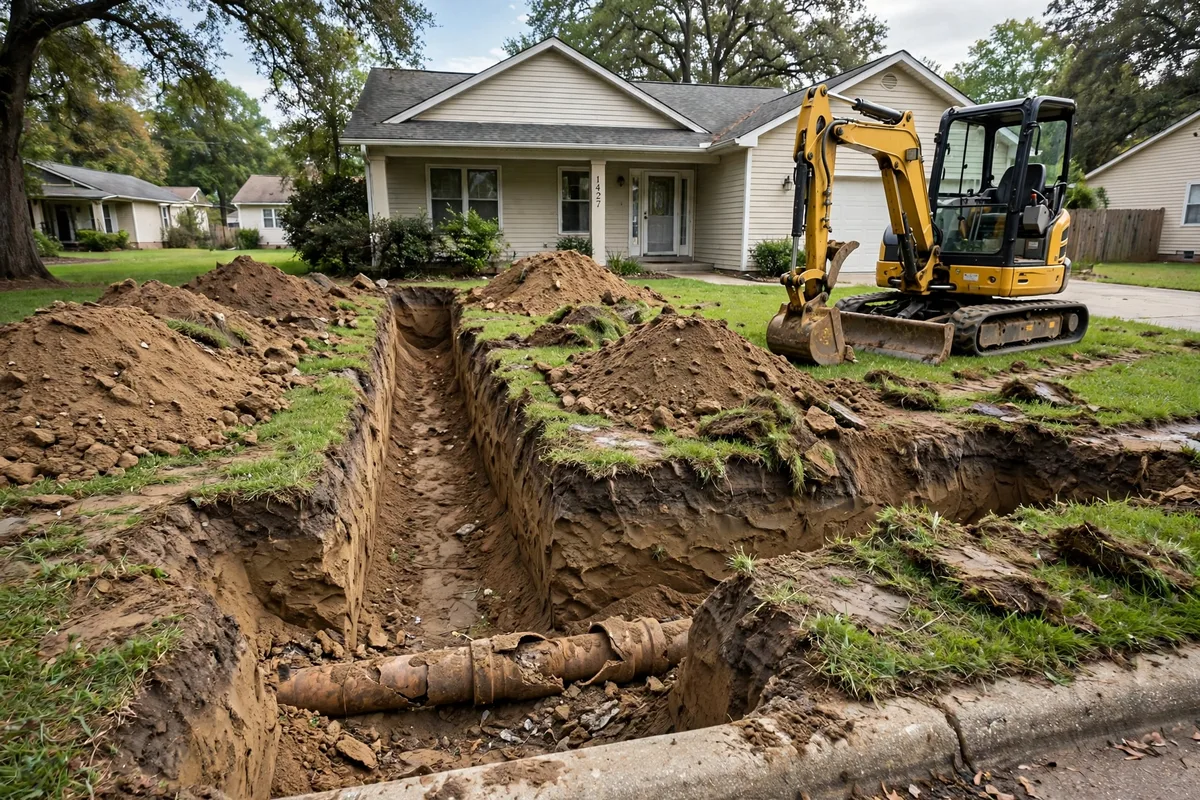
Traditional digging gets the job done but adds days of labor and a full restoration afterward.
What Shapes the Work in Ohio?
Six factors matter more than anything else:
| Factor | Why it changes the plan |
|---|---|
| Depth | Ohio basements put laterals 8–10 feet down in many homes. Deeper pipe means more excavation or longer equipment runs. |
| Length | A 30-foot run to the curb is a smaller job than a 90-foot run to a main at the back of a deep lot. |
| Pipe material and condition | Sound clay tile is a lining candidate; flattened Orangeburg usually needs bursting or digging. Worse condition means a bigger job. |
| Access | A clear sewer cleanout keeps trenchless work simple. Concrete patios, decks, or additions built over the line complicate the job. Before any digging, call 811 (call811.com) to have utilities marked. |
| Soil and water | Rocky soil, high water tables near Lake Erie or the Ohio River, and hillside sites all complicate the work. |
| Permits and inspections | Every Ohio municipality requires them, and inspection scheduling is part of any honest plan. Ohio EPA oversees Ohio's wastewater programs at the state level. |
Does Homeowners Insurance Cover Any of This?
Usually not under a standard policy: wear and tear, age, and root intrusion are standard exclusions. But two endorsements are worth knowing about. Service line coverage, offered by many Ohio insurers, can help cover lateral repair work. Sewer backup coverage is a separate endorsement that covers damage when sewage backs into the home. Neither helps if you buy it after the failure. Check your policy now, before you need it, and call your agent with questions.
How Can You Avoid Surprises?
Four rules protect Ohio homeowners on every sewer job:
- Watch the camera footage yourself. If a contractor won't show you what's wrong, get a second opinion.
- Get the plan in writing before work starts. Fixed plan, scope defined, no "we'll see once we're down there."
- Ask about trenchless. Some dig-only contractors never mention lining or bursting. You deserve both options.
- Fix it early. A lining job today beats an emergency replacement after a collapse, and emergency scheduling always adds complications.
The simplest sewer repair is the one you do before the pipe fails completely. If your drains are slowing, your yard has a suspiciously green stripe, or your home's line has never been inspected, a camera look now is the smartest move.

A real plan is itemized and in writing before work starts. If a contractor will not put it on paper, get another opinion.
Related Articles
- Trenchless vs Traditional Sewer Repair: An Honest Comparison
- How Long Does Sewer Line Replacement Take?
- What Happens When You Ignore a Slow Drain
Related Services
- Sewer Camera Inspection: See the line before any work starts
- Trenchless Sewer Repair: No-dig repair through small access points
- Spot Sewer Repair: Fixes one damaged section without replacing the line
Ohio Sewer Repair FAQs
Depth, length, pipe material, soil conditions, access, permits, and the repair method. A shallow 30-foot spot repair and a 90-foot collapsed line under a driveway are different jobs that happen to share a name. A camera inspection is the only way to define the work for your specific line.
It depends on your line and your property. Trenchless work avoids an open trench, so there is little or no restoration afterward: no new driveway, sidewalk, landscaping, or patio to rebuild. Digging is the right call when the line is severely misaligned, has no access points, or needs a new route.
Because no two lines are alike. Depth, length, pipe material, soil conditions, access, permits, and the repair method all shape the plan. That is why reputable contractors insist on a camera inspection before defining the work.
Standard homeowners policies usually exclude sewer line wear and tear, but many Ohio insurers offer a service-line endorsement that helps cover repair work. Sewer backup coverage is a separate endorsement worth asking about. Check your policy or call your agent before you need it; you cannot add coverage after the line fails.
Get a camera inspection and watch the footage yourself, get the plan in writing before work starts, and be wary of anyone who defines the work without looking. Ask whether trenchless is an option, some dig-only contractors will not mention it. And fix small problems early: a lining job today beats an emergency replacement after a collapse.
Want to Know What Your Line Needs? It Starts With a Camera.
We'll inspect your line, show you the footage, and give you a fixed written plan, anywhere in Ohio.
Call (614) 350-5706